In short: when your car comes to a halt at night, a charged car emergency flashlight (or torch) helps you see where you are stepping and be seen by oncoming traffic, without draining your phone battery. If it also has a glass breaker and a seatbelt cutter, it can help you get out after an accident. Keep it charged, out of the sun and within reach of the driver's seat with your seatbelt fastened.
Updated 20 November 2026. The information on the Italian Highway Code is for guidance only: it is not legal advice. This guide refers to Italian law. Rules differ from country to country: check the regulations where you live.
Why your phone is not enough
When your car breaks down, you need your phone to call for help, let people find you and, if necessary, stay in contact for hours. Using it as a light as well drains it just when it is most valuable. On top of that, its light is weak, doesn't reach far and takes up one of your hands.
A dedicated flashlight solves these problems: it has its own battery and a stronger light, and with a magnetic base you can attach it to the car and work with both hands free.
Car stopped or accident: what to do, step by step
The first thing to protect is you, not the car. Here is the order to follow, with the obligations of the Italian Highway Code (Codice della Strada).
-
Switch on your hazard lights as soon as you realise you need to stop, and try to reach an exit, a service area or a car park. On the motorway, the hard shoulder and emergency lay-bys are dangerous: use them only if you have no alternative.
-
Pull over as far to the side of the road as possible, out of the traffic lanes. At night or in poor visibility, also leave your sidelights on.
-
Put on your high-visibility vest before getting out. Keep it inside the car, not in the boot. Make sure any passengers who get out wear one too.
-
Get out on the side away from the traffic, if you can, and have everyone get out on the same side. With children and animals, decide where to go before opening the doors.
-
Get to a safe place. On motorways and fast roads, the safest choice is to wait behind the crash barrier, away from the car. Be careful on viaducts and bridges: there may be a sheer drop behind the barrier.
-
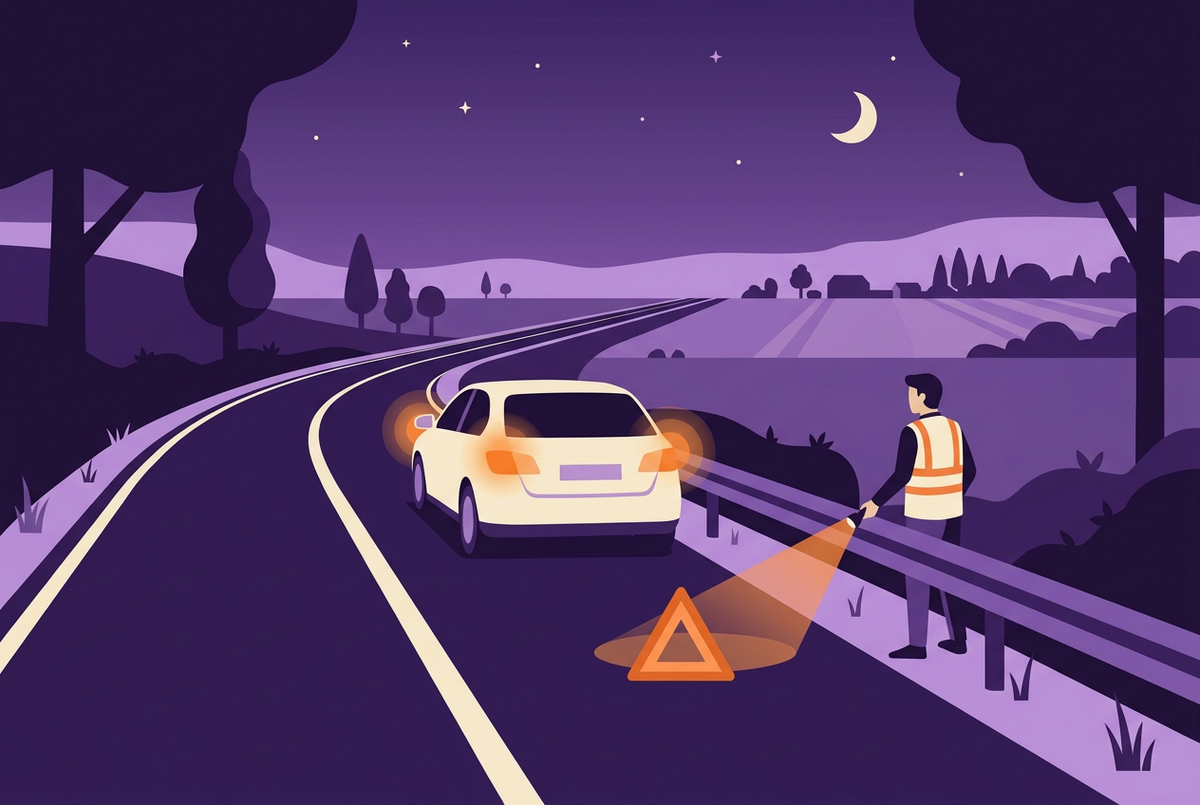
Place the warning triangle behind the car, at the distances shown below. Walk along the outer edge, wearing your vest and with the flashlight on and pointed at the ground. If traffic, a bend or fog makes walking along the road too dangerous, get to a safe place and tell the operator straight away when you call.
-
Call for help and say where you are: road, direction of travel, kilometre marker or the last sign you saw.
What the Italian Highway Code says
| Obligation |
When |
Reference |
| Hazard lights on |
When the car is obstructing the carriageway, while you place and collect the triangle, and during emergency stops that create a hazard |
Art. 153, paragraph 7 |
| Retroreflective vest or braces worn to get out and move about on the road |
Outside built-up areas, when the stopped car is not clearly visible (at night, for example), including on the hard shoulder or in a lay-by |
Art. 162, paragraph 4-ter |
| Triangle at least 50 metres behind the car, visible from 100 metres |
Outside built-up areas, when the car stopped on the carriageway cannot be seen clearly (at night with faulty lights, or by day if it is not visible from 100 metres) |
Art. 162 and art. 357 of the Implementing Regulation |
| Triangle at least 100 metres behind the car |
On motorways and main extra-urban roads, if the car cannot be moved onto the hard shoulder or into a lay-by |
Art. 176, paragraph 8 |
The law sets the minimum. On a bend or just after a rise in the road, it is better to place the triangle further back, so that approaching drivers see it in time.
Who to call
-
112, the single emergency number that works across the EU: if anyone is injured, if the car is blocking the road, if there is smoke or another hazard.
-
Your insurer's assistance number or your motoring club's, if you have breakdown cover.
-
803.116, the roadside assistance number of ACI (Automobile Club d'Italia) in Italy, available 24 hours a day. The call is free; the call-out is charged if you are not a member and have no cover that includes it.
-
The SOS call points on the motorway, if your phone isn't working.
Only use numbers you already know. Be wary of websites found through a quick search that ask for payment up front to send you a tow truck.
After an accident, don't move an injured person unless there is an immediate danger such as fire or water. Wait for the emergency services and follow the instructions of the 112 operator.
Tempered and laminated glass: the difference that matters
A glass breaker only works on one type of glass. Before relying on it, you need to know what your car has.
|
Tempered (toughened) glass |
Laminated glass |
| What it is |
A single heat-treated pane |
Two panes bonded to a plastic film |
| When it breaks |
It shatters into lots of small, fairly blunt pieces |
It cracks, but the film holds it together |
| Where you find it |
Often in the side windows and the rear windscreen |
Always in the windscreen; in several models, in the side windows too |
| Does the glass breaker work? |
Yes, if the blow is firm |
No: in independent tests, no tool got through it |
Laminated side windows are becoming more and more common, because they reduce noise and help keep occupants inside the car in a crash. In the United States, AAA calculated that as early as 2018 about one in three new models had them on at least one window. The same type of glass is also found in Europe, sometimes as an "acoustic" option. In its 2025 test, the German automobile club ADAC was unable to break the laminated side windows of one of the cars tested with a hammer or a punch.
How to tell what glass your car has
-
Look at the marking printed in one corner of each window. It often includes the word for the type of glass, such as "laminated" or "tempered".
-
Check every window: the same car can have laminated front windows and tempered rear ones.
-
If the marking is unclear, look in the owner's manual or ask the dealer or the manufacturer. The model's rescue sheet, designed for firefighters, may also show where the laminated windows are.
-
Note down the result and decide in advance how you would get out: for example through a tempered rear side window or the rear windscreen.
The glass breaker: how it works and what its limits are
A glass breaker is a small, very hard tip. It concentrates the force of the blow on a tiny point, and that is enough to make tempered glass give way, glass you could not break with your hand or elbow. It is not a guaranteed result, though: it takes a firm blow, sometimes more than one.
In AAA's 2019 test, six tools were tried on tempered glass: only four broke it. Spring-loaded models, which fire when you press them against the glass, worked better than hammer-style ones. None of the six got through laminated glass.
What can make it hard to use
- The window is laminated.
- After a crash you are trapped, injured or in an awkward position, and cannot strike firmly.
- You aim at the centre of the glass, where it flexes and absorbs the blow.
- The tool is not within reach: in a closed glovebox or in the boot, it is no use.
How to use it
- Choose a tempered side window, as far as possible from you and your passengers.
- Aim at a corner of the glass, near the edge, not the centre.
- Turn your face away and protect your eyes with your free arm.
- Strike sharply with the tip, holding the tool firmly. If the glass doesn't give way, repeat.
- Widen the opening by pushing the fragments away with the tool or a shoe, not with your bare hands.
The seatbelt cutter: how it works and what its limits are
After a crash the seatbelt buckle may not release, or the belt may stay taut under your body weight. A seatbelt cutter is a small blade hidden in a hook-shaped slot: the belt webbing fits in, your fingers don't.
- First try to release the belt with the buckle button: it is always the quickest way.
- If it won't release, slip the webbing into the slot.
- Keep it taut and pull with a firm, continuous movement.
- If the car has overturned, brace one hand against the roof before cutting: when the belt gives way, you will drop downwards.
A seatbelt cutter only works well if the webbing is taut and the slot is free of dirt. You can't test it on your car's seatbelts, but you can practise the movement, or try it on a scrap piece of nylon webbing, so that in an emergency you won't have to think about it.
Car in water: speed is what counts
In its 2025 test, ADAC recommends acting immediately, within the first minute, without waiting until the door can be opened:
- release your seatbelt;
- lower the window as soon as possible: in the test, one car's electric windows still worked in the water, but don't count on that always happening;
- if the window won't open, break a tempered side window or the rear windscreen, striking a corner;
- get out and help children and passengers.
Here too, laminated side windows won't break: that is why it pays to know in advance which window to use to get out.
Where to keep your car emergency flashlight
-
Within reach with your seatbelt fastened: the driver's door pocket or the compartment between the seats. The glovebox in front of the passenger usually can't be reached from the driver's seat.
-
Secured: in a crash or under hard braking, a loose object flies around the cabin. Choose a compartment where it stays put.
-
In the shade: never on the dashboard or the rear parcel shelf in the sun.
-
Always in the same place, so you can find it even in the dark. If other people travel in the car, tell them where it is.
The magnetic base: why it is useful and how to assess it
A magnet in the base of the flashlight lets you attach it to a steel part of the car. It is the simplest way to keep your hands free and the light pointed where you need it:
- under the bonnet, to check the oil level or the battery terminals;
- on the bodywork near the wheel, to change it in the dark;
- stood upright, to light up the ceiling and spread light over a wide area.
Before relying on it, bear these limits in mind:
- the magnet only holds on steel, not on aluminium or plastic, and some cars have an aluminium bonnet or other aluminium body panels. Test first with any ordinary magnet;
- check that the magnet also holds vertically and with some vibration;
- with the engine running, keep it away from belts and fans, and don't put it on very hot parts such as the exhaust;
- to avoid scratching the paintwork, put a thin cloth between the magnet and the bodywork;
- if you have a pacemaker or another implanted device, ask your doctor how far away to keep magnets.
Lumens, modes and runtime: how to read the numbers
Flashlights come with lots of numbers. Here is what they mean.
-
Lumens: the total amount of light coming out of the flashlight. More lumens means more light, but also more power consumption.
-
Beam distance and candela: these tell you how far the light reaches. Two flashlights with the same lumens can light up different distances, because one concentrates the beam and the other spreads it.
-
Runtime: how long the battery lasts in a given mode.
The highest levels, such as turbo, are used for a few minutes at a time: they heat up the flashlight and use more battery.
In practice, having the right levels matters more than maximum power:
| Mode |
When to use it in the car |
| Low |
Looking for something in the cabin or reading a document, without dazzling the people with you |
| Medium |
Working on the car for a long time: it is the best compromise between light and runtime |
| High and turbo |
Looking into the distance, for example at the edge of the road or a ditch, for a few minutes |
| Strobe |
Signalling where you are. Never point it into drivers' eyes and don't use it instead of the warning triangle |
Lithium batteries: how to look after them in the car
Almost all rechargeable flashlights use lithium-ion batteries. In the car they are exposed to heat and cold, their main enemies.
-
Summer heat. In an Arizona State University study, with outside temperatures above 35 °C, after an hour in the sun the dashboard reached an average of about 69 °C and the cabin about 47 °C. Heat reduces battery capacity, especially when the battery is 100% charged. Keep the flashlight in a closed compartment, in the shade; in the hottest months, if the car is left in the sun for hours, consider taking it with you.
-
Winter cold. In the cold the battery performs less well and the light may last less than usual. Common lithium batteries should not be charged below 0 °C: if the flashlight is frozen, let it warm up to room temperature before charging it.
-
Storage charge. An emergency flashlight must be ready, so keep it charged. If, on the other hand, you have a spare flashlight that sits unused for months in a drawer at home, storing it at about half charge, in a cool place, makes it last longer.
-
Checks. Switch it on once a month and recharge it after every use. Every two or three months, give it a full charge.
-
Spare battery. If the battery is removable and you have a spare, carry it in a plastic case: in contact with keys or coins it can short-circuit.
-
Warning signs. If the battery swells, gets unusually hot or leaks, stop using it and take it to a battery collection point.
What to keep within reach of the driver's seat
Not everything needs to be in the cabin, but these things do, because you need them before getting out or if you can't get out:
- the charged flashlight, with a glass breaker and seatbelt cutter if you want them;
- the high-visibility vest, one for each passenger if you can;
- your phone, with a car charger or a charged power bank;
- useful numbers written on paper: your insurer's assistance line and, in Italy, 803.116.
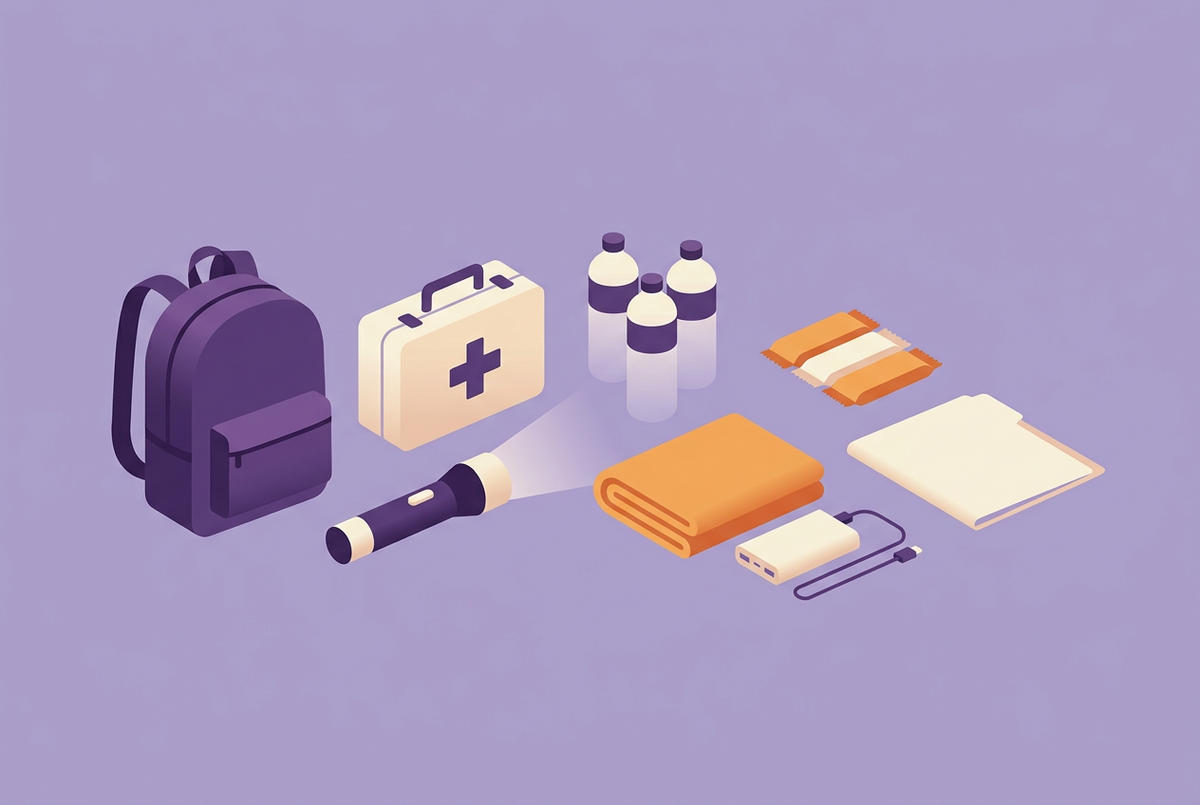
The warning triangle, first aid kit, foil blanket, water and tools can go in the boot, well secured. The full list, with the hiking kit and the home kit, is in our guide to the emergency kit: what to keep in the car, in your backpack and at home.
Maintenance: a simple schedule
| When |
What to do |
| After every use |
Recharge the flashlight and put it back in its place |
| Every month |
Switch it on and try all the modes; in summer, check it hasn't been left in the sun |
| Every 2–3 months |
Full charge; clean the seatbelt cutter slot and check that the glass breaker tip is firmly attached |
| Every year, or when you change car |
Check again which windows are laminated and go over with the people who travel with you how you would get out |
TactiBeam: technical specifications
Our flashlight with these features is TactiBeam. Here are its specifications.
| Feature |
Specification |
What it means in practice |
| Light |
3 Cree XHP35 LEDs, 5 modes:
Low: 100 lumens
Medium: 400 lumens
High: 800 lumens
Turbo: 1,300 lumens
Strobe
Switches off with one click. |
Turbo is for short bursts; for working, use low or medium |
| Battery |
2,200 mAh rechargeable, included, with USB-C charging |
You can recharge it at home, from the car's USB socket or from a power bank |
| Runtime |
Up to 6 hours in medium mode |
In high and turbo modes the battery lasts less |
| Water |
IPX7 |
Withstands temporary immersion: under the IP rating system, up to 1 metre for 30 minutes |
| Tools |
Steel glass breaker and seatbelt cutter |
The limits explained above apply, starting with laminated glass |
| Base |
Magnetic |
Only holds on steel parts |
| Body |
Aluminium, impact-resistant |
Light and sturdy, suitable for keeping in the car |


Frequently asked questions
Where should you keep an emergency flashlight in the car?
In a compartment you can reach from the driver's seat with your seatbelt fastened, such as the door pocket or the compartment between the seats. It must stay put when you brake and be kept in the shade, never on the dashboard.
Does the glass breaker work on all windows?
No. It works on tempered glass, which shatters. It won't get through the windscreen or laminated side windows, which several recent models have at least at the front. Check the marking in one corner of each window and decide in advance how you would get out.
How can I tell if a window is laminated?
Read the marking printed in the corner of the glass: it often says "laminated" or "tempered". If it is unclear, ask the dealer or the manufacturer. Check every window, because they can differ within the same car.
Can I leave a rechargeable flashlight in the car in summer?
Yes, but in a closed compartment and in the shade. On the hottest days a dashboard in the sun can go above 60 °C, and heat damages lithium batteries, especially when they are fully charged. If the car is left in the sun for hours, take the flashlight with you.
How many lumens does a car flashlight need?
For the cabin and for working on the car, the low and medium modes are enough. High power is only needed to see into the distance, for a short time. Several light levels and a good runtime matter more than maximum lumens.
Does the flashlight replace the warning triangle or the vest?
No. In Italy, the vest and the triangle are required by the Highway Code and must be used regardless. The flashlight helps you see where you are stepping and be noticed while you use them.
Sources
- Italian Highway Code (Codice della Strada), art. 153 (use of lights and hazard warning): Normattiva
- Italian Highway Code (Codice della Strada), art. 162 (warning of a stationary vehicle, high-visibility vest): Normattiva
- Italian Highway Code (Codice della Strada), art. 176 (motorways and main extra-urban roads): Normattiva
- Implementing Regulation of the Italian Highway Code (DPR 495/1992), art. 357 (position of the warning triangle): Normattiva
- Autostrade per l'Italia, leaflet with safety advice on the hard shoulder: autostrade.it
- Federal Roads Office (Switzerland), what to do in the event of a breakdown or accident: astra.admin.ch
- ACI, the 803.116 number and services for private motorists: L'Automobile, July 2026 and L'Automobile, November 2024
- AAA, test of vehicle escape tools (2019): newsroom.aaa.com
- ADAC, cars in water and escape test (2025): adac.de
- Battery University, storing batteries (BU-702) and charging at high and low temperatures (BU-410): BU-702, BU-410
- Arizona State University, temperatures in cars parked in the sun (2018): news.asu.edu
- TactiBeam: product page
By the Hesago Team
We are an Italian shop specialising in personal safety and outdoor gear, and we ship our products from Italy.