In short: how does a personal alarm work? It's a small battery-powered device that, when you pull the ring, sounds a very loud siren and flashes a light. It's there to attract the attention of people nearby and to give you a few seconds to get away. It doesn't call the emergency services, doesn't send your location and doesn't guarantee that anyone will step in: to ask for help you always need your phone. SnapSiren, the model we use as an example, also has a flashlight and a mode that turns it into a door and window alarm. Its siren reaches 135 decibels.
Updated 20 November 2026. This guide refers to Italian law. Rules differ from country to country: check the regulations where you live.
How does a personal alarm work? The short version
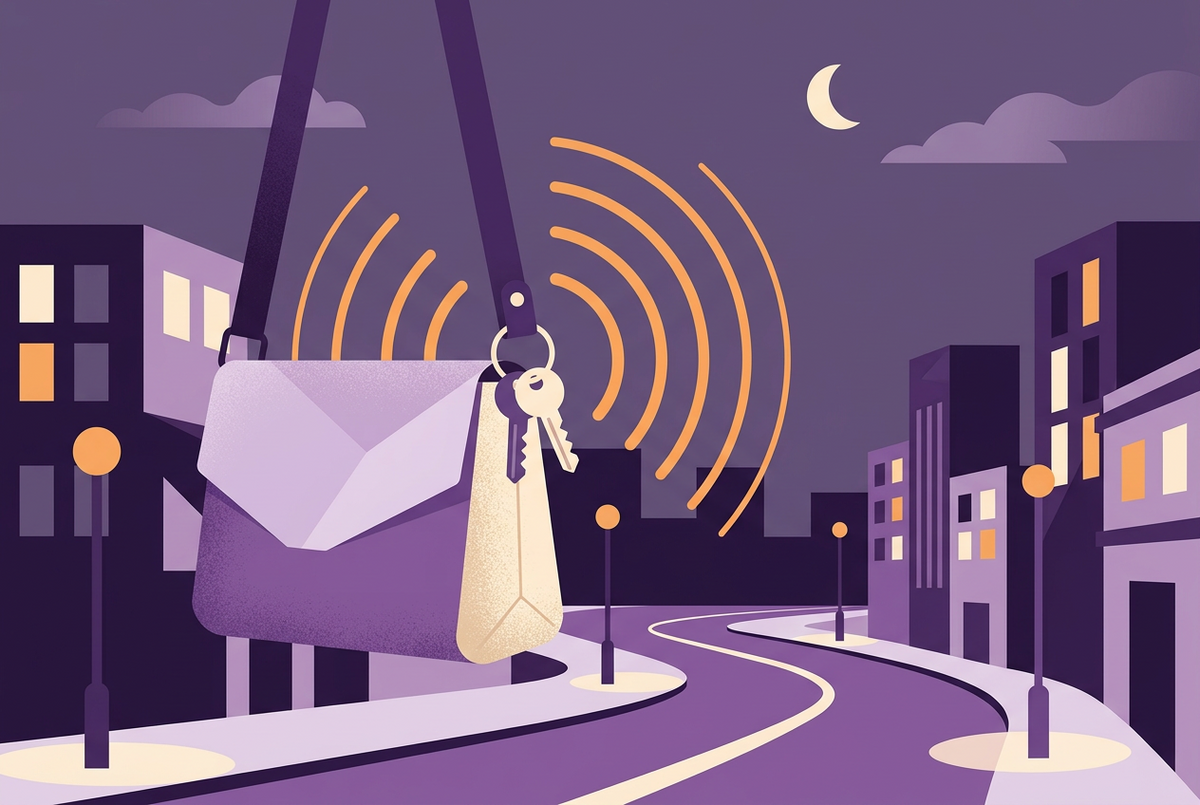
A personal alarm contains four elements: an activation trigger, an electronic siren, a light and a rechargeable battery. On SnapSiren the trigger is a ring: you attach it to your bag or backpack and, when you pull it, the siren starts together with the flashing light. It keeps sounding until you put the ring back in place.
The strength of this system is its simplicity: a single movement, made with one hand, even in the dark and without looking. There are no codes to remember, apps to open or buttons to find.

SnapSiren, step by step
Let's take SnapSiren, our personal safety alarm, as an example. It measures about 9 x 3 cm, weighs 25 grams and has two modes: the personal siren and Smart Alarm for doors and windows. On the underside there's a button, the USB-C charging port and a small charging indicator light.
1. Activating the siren: pull the ring
Attach the ring to a bag or a loop, so SnapSiren is always to hand. When you pull the ring the siren starts and, at the same moment, the LED light starts flashing. The alarm keeps sounding even if you let go of the device: your hands are free to get away and make a call.
2. Turning the siren off: put the ring back
To stop the siren, put the ring back into its slot. Practise at home, calmly, until the movement feels natural: when you really need it, you don't want to be wondering how to turn it off.
3. The light: flashing with the siren, a flashlight when you need it
During the alarm the LED light flashes, so people nearby can tell more quickly where the sound is coming from. The same light also works as a flashlight: press the button on the underside and it comes on, first steady, then flashing; press again and it switches off. It's handy for finding your keys or the lock in the dark.
4. The battery: charging, run time and warnings
-
Charging. Use the USB-C cable supplied. A small red light stays on while it charges and goes off when charging is complete. It takes about 2 hours, depending on the power of the charger.
-
Before first use. Charge it fully before using it for the first time.
-
Run time. About 1 hour of continuous alarm, or 2 hours of light.
-
Low battery. SnapSiren gives 3 beeps and 3 flashes. When you hear them, recharge it as soon as you can.

5. Smart Alarm mode for doors and windows
The second mode turns SnapSiren into a small alarm to place against a door or a window. Here's how it works:
- Press and hold the button on the underside for 3 seconds: a beep confirms the mode is on.
- Within 10 seconds, place SnapSiren in contact with the door or window you want to monitor.
- After 10 seconds the sensor activates and a flash of light confirms it.
- From then on, any movement or vibration sets off the siren and light. To stop the alarm, or to turn the mode off, press the button on the underside.

A few practical tips for using it well:
-
A stable position. Place it at the bottom of the door, in contact with it as in the photo, so that opening the door moves it or makes it vibrate. Check that it can't fall over by itself.
-
Test it before you go to sleep. Turn the mode on, wait for the confirmation flash and open the door slowly: if it sounds, the position is right. Stop the alarm with the button and turn the mode on again. In a hotel, do the test during the day, or keep it very short, out of consideration for people sleeping in nearby rooms.
-
Avoid false alarms. Since it also reacts to vibration, don't place it where things vibrate on their own, such as a window that rattles in the wind or a piece of furniture next to an appliance.
-
Remember what it doesn't do. It only sounds where it is: it doesn't alert anyone outside and doesn't replace a burglar alarm system.
135 decibels: what it means and why distance matters
The decibel (dB) measures the level of a sound on a logarithmic scale: every 10 dB more means ten times more sound energy and, to the ear, a sound that seems roughly twice as loud. Some reference points, according to the CDC, the US federal public health agency:
- normal conversation is roughly between 60 and 80 dB;
- above 85 dB, exposure can become harmful to hearing;
- police, fire and ambulance sirens, up close, are between 110 and 129 dB, enough to lose some hearing in less than a minute;
- fireworks reach 140–160 dB.
How sound changes with distance
Sound level drops with distance: outdoors and without obstacles, every time the distance doubles it falls by about 6 dB. Walls, cars, trees, wind and traffic noise also reduce the sound that reaches the listener, and so does a pocket or a hand over the speaker: when it's sounding, leave it uncovered.
Protect your ears
- Never hold the alarm close to anyone's ears, yours or other people's, while it's sounding, and don't use it as a joke.
- When you test it, do it for a second or two, at arm's length, with the speaker pointing away from you.
- Warn anyone at home and keep young children and pets away.
Where to keep it and how to check it
Where to keep it
-
Clipped on with the ring to your bag's shoulder strap, your backpack strap or a belt loop, on the side of the hand you use most. The body of the alarm should stay outside the bag, where your hand can find it without searching.
-
Near your keys, if you usually have them in your hand when you reach your front door or your car.
-
For running or walking, on a shoulder strap or a belt, not in a zipped pocket.
-
For children and teenagers, on the backpack strap, not inside the backpack.
-
Avoid: the bottom of your bag, places where the ring can snag and pull out by itself, and the car dashboard in summer. Don't expose it to temperatures above 60 °C.
Practise the movement without activating it
Once it's attached, practise finding the alarm with one hand and without looking, stopping before you pull. It takes a few seconds, but it makes the movement automatic.
Regular checks
| When |
What to do |
| The first time |
Charge it fully: the red light goes off when charging is complete. Test the siren for one second and turn it off by putting the ring back. Test the flashlight and Smart Alarm mode too. |
| Every month |
Put it on charge even if you haven't heard the warning. Check that the ring goes back into its slot properly, that the attachment to your bag is secure and that the USB-C port is clean and dry. |
| Every two or three months |
A one-second siren test, outdoors or after warning anyone at home. |
| Before a trip |
A full charge and a test of Smart Alarm mode. |
| After real use or a night in Smart Alarm mode |
Put it back on charge. |
| If you hear 3 beeps with 3 flashes |
The battery is low: recharge it as soon as you can. |
| After a fall or if it gets wet |
Dry it, check for cracks and test the siren and light. Don't charge it until it's completely dry. |
If the device is damaged, deforms or gets unusually hot, stop using it and contact customer support. The lithium battery cannot be removed: it can only be replaced by the service centre or a qualified technician. Don't open it and keep it away from fire. At the end of its life it must not go in general waste: take it to a municipal collection point for electronic waste (WEEE, known in Italy as RAEE) or return it to the shop when you buy an equivalent device.
Personal alarm or whistle?
A whistle is the simplest sound signal there is, and many people already carry one in their hiking kit. Here's how the two compare.
| Aspect |
Personal alarm (SnapSiren) |
Whistle |
| How you use it |
Pull the ring and it sounds by itself until you put the ring back |
You have to blow: every blast takes breath |
| If you're out of breath or frozen with fear |
One movement is enough |
It can be hard to blow loudly and for long |
| Hands and mouth |
Once activated, it keeps sounding even if you let go: your hands are free to make a call |
Takes up your mouth and often one hand |
| Duration |
About 1 hour of continuous alarm on a full battery |
As long as you can keep blowing |
| Volume |
135 dB |
Depends on the model and on your breath |
| Light |
Flashing light with the siren, plus a flashlight |
None |
| Rhythmic signals |
Continuous sound, not suited to sequences |
You can blow series of blasts, like the distress signal used in the mountains |
| Power and maintenance |
Needs recharging, protecting from heat and keeping dry |
No battery, almost no maintenance |
| In a room or at home |
Smart Alarm mode for doors and windows |
No specific use |
| Limits |
Doesn't call the emergency services, doesn't send your location, only helps if someone can hear it |
The same: it doesn't call anyone and only helps if someone hears it |
In town, a personal alarm is more immediate, because one movement is enough and then it sounds by itself. In the mountains and on treks, the whistle remains a classic, because it has no batteries and lets you make rhythmic signals: the Italian Alpine Club (CAI) describes an alpine distress signal made up of series of sound or light signals, each followed by a pause. The two don't rule each other out, and neither replaces your phone. For the rest of your backpack, read our guide to the emergency kit for your car and backpack.
When it can help
A personal alarm isn't for doing something to someone: it's for changing what happens around you, by making the people nearby turn round. It works best where there's someone who can hear it.
-
Walking home at night, from work, from the station or after a night out. The habits that matter most, even before any tool, are in our guide to self-defence for women.
-
Running and walking in parks or on quiet routes.
-
Children and teenagers coming home from school or from training: the movement is easy to explain.
-
Older people who go out alone: the siren can alert neighbours and passers-by. However, it doesn't alert family or emergency services remotely: that's what telecare devices are for, and they're a different thing.
-
Hiking: a loud sound helps people nearby work out where you are, along with a whistle and your phone. If you often walk in the countryside, also read what to do if an aggressive dog approaches.
-
Travel: in a hotel or a rented flat, with the door and window mode.
What a personal alarm can't do
-
It doesn't call the emergency services. SnapSiren isn't connected to your phone: it doesn't call 112 and doesn't send your location to anyone.
-
It doesn't guarantee that anyone will step in. It can attract attention, but the people around you may not hear, understand or react. In an isolated place its main job is to give you a moment to get away.
-
It only works if it's charged and within reach. At the bottom of your bag or with a flat battery, it won't help you.
-
It doesn't replace prevention. Well-lit routes, awareness of what's going on around you and a plan remain the foundation.
After activating it
- Move away towards a well-lit place where there are other people.
- Call 112, or use your phone's SOS feature if you've set it up: in our guide to self-defence for women we explain how to activate it on iPhone and Android.
- When you're safe, turn off the siren by putting the ring back, and put the alarm back on charge.
Frequently asked questions
Does a personal alarm call the emergency services?
No. SnapSiren produces sound and light, but it isn't connected to your phone, doesn't call 112 and doesn't send your location. To ask for help you need to make a call or use your smartphone's SOS feature.
How far away can you hear a 135 dB alarm?
135 dB confirms that it's a very loud alarm. Outdoors, the level drops by about 6 dB every time the distance doubles.
How do you turn SnapSiren off?
If you activated it by pulling the ring, turn it off by putting the ring back into its slot. If it went off in Smart Alarm mode, press the button on the underside.
How long does the battery last and how long does it take to charge?
With a full battery SnapSiren gives about 1 hour of continuous alarm or 2 hours of light, and it charges in about 2 hours with the USB-C cable. When the battery is low, SnapSiren gives 3 beeps and 3 flashes. Our advice is to charge it once a month, before every trip and after every use.
Personal alarm or whistle: which is better?
It depends on how you'll use it. The alarm takes just one movement and then sounds by itself, so it's more practical in town. The whistle has no batteries and lets you make rhythmic signals, which is why it's a classic in mountain kit. You can carry both, along with your phone.
Can I use it as an alarm for my front door?
Yes, with Smart Alarm mode: placed against the door or window, it sounds if it detects movement or vibration. It's a simple solution for a night somewhere new or when you're home alone, but it doesn't alert anyone outside and doesn't replace a burglar alarm system.
Is it suitable for a young person or an older person?
Yes, the movement is simple: just pull the ring. Explain clearly when to use it and do a short test together at home, away from your ears, so the sound doesn't come as a surprise at the wrong moment. Show them how to turn it off too.
Can an alarm replace pepper spray?
They're different tools: the alarm doesn't require aiming and is there to attract attention. If you're also considering a spray, first read our guide on legal pepper spray in Italy.
Sources
Pages and documents consulted on 17 November 2026.
By the Hesago Team
We are an Italian shop specialising in personal safety and outdoor gear, and we ship our products from Italy.