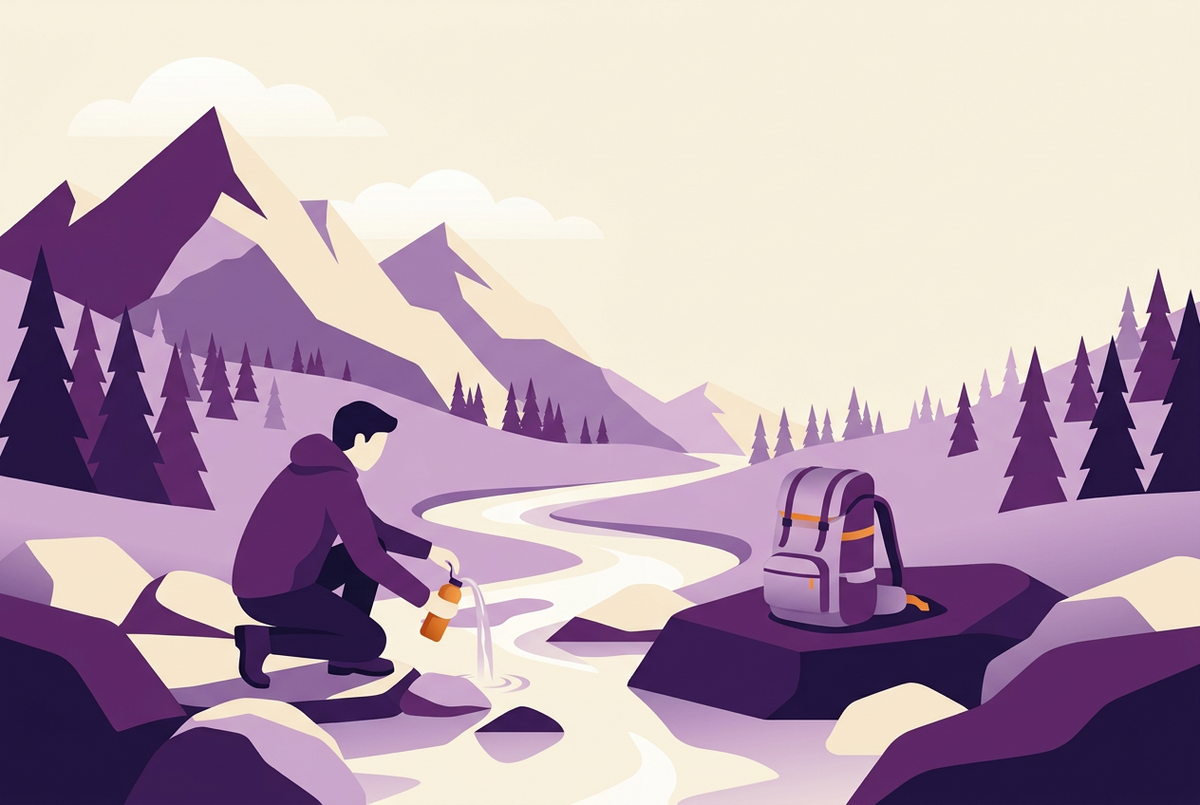
In short: water from streams, springs and lakes can be cold and clear and still contain bacteria, parasites and viruses. It needs treating before you drink it. To make water safe to drink when hiking in the mountains, you have four options: boiling, chemical disinfection with tablets, filtration and UV light. Boiling is the most reliable against all microorganisms. A filter with very fine pores removes bacteria and protozoa; against viruses you need a filter that is also rated for viruses, boiling, tablets or UV light. None of these methods removes chemicals: if you suspect pollution, find another source.
Updated 20 November 2026. This guide refers to Italian law. Rules differ from country to country: check the regulations where you live.
Can you drink water from a mountain stream?
Not without treating it. A high mountain stream can be cold, clear and fast-flowing and still have a pasture, a bivouac hut or a dead animal a little further upstream. Contamination is invisible and usually changes neither the colour nor the taste. The CDC, the United States public health agency, also points out that water containing germs can sometimes look clean.
Surface water can carry four kinds of problem:
-
Bacteria, such as Escherichia coli, Salmonella and Campylobacter. They come mainly from animal and human faeces.
-
Protozoa, such as Giardia and Cryptosporidium. These parasites form very hardy cysts and oocysts: Giardia survives for weeks or months outside the body, and Cryptosporidium even resists chlorine.
-
Viruses, such as norovirus and hepatitis A virus, which are much smaller than bacteria. They come mainly from sewage and human faeces: the risk increases near mountain huts, bivouacs, villages and busy trails.
-
Chemicals and toxins: agricultural residues, fuels, metals, algal toxins. No hiking method makes them safe.
The most common symptoms of an infection caught from contaminated water are diarrhoea, stomach cramps, nausea and vomiting. They can appear days later: with Giardia, usually after one or two weeks. If the symptoms persist, or if you have a high fever, blood in your stools or signs of dehydration, see a doctor.
Why the source matters: streams, lakes, springs, pastures and mountain huts
You choose the treatment by looking at where you collect the water. The more human and animal activity there is upstream, the higher the risk, especially for Cryptosporidium and viruses.
-
High mountain streams, away from pastures and huts. These are usually the best choice: the water is flowing and there are few sources of contamination upstream. But "usually" is not a guarantee, so treat the water anyway.
-
Streams below alpine pastures, mountain dairy farms and grazing land. Cow, sheep and goat faeces can carry E. coli, Giardia and Cryptosporidium into the water. If you can, walk upstream and collect water above the pasture. Otherwise, choose a method that also works on Cryptosporidium: boiling, a filter with pores below 1 micron, or UV on clear water.
-
Water near mountain huts, bivouacs, villages and car parks. There may be sewage outlets and latrines here, so viruses too. For surface water near human or animal activity, the CDC recommends boiling, UV light, an ultrafilter, or a microfilter followed by chemical disinfection.
-
Lakes, ponds and still pools. Stagnant water warms up, collects dirt and can host algal blooms. Avoid water with foam, green scum or a "pea soup" look. Algal toxins are not removed by boiling: the Minnesota Department of Health warns that boiling can even concentrate them.
-
Springs and fountains without a sign. A spring coming out of the rock looks clean, but without testing you don't know what path the water has taken. If a fountain has a "drinking water" sign (in Italy, "acqua potabile"), it is managed as a drinking-water point. If the sign says "not drinking water" or "untested" ("acqua non potabile", "non controllata"), or if there is no sign at all, treat it as surface water. In mountain huts, ask the hut keeper.
-
After a storm or during the thaw. Rain and melting snow wash soil and dirt into streams: the water becomes cloudy and more contaminated. If you can, find another source or wait. Either way, clarify it before treating it.
-
Water near roads, cultivated fields, mines or industrial plants. Here the risk is chemical. No hiking filter and no tablet solves the problem: find another source.
Which treatment for which source
| Situation |
Main risk |
What to do |
| Clear water, little human or animal activity upstream |
Bacteria and protozoa |
One method used properly: boiling, filter, tablets or UV |
| Clear water near pastures, mountain huts or villages |
Cryptosporidium and viruses as well |
Boiling, UV, an ultrafilter tested against viruses, or a filter followed by a tablet |
| Cloudy water |
Particles that shield germs and clog filters |
First let it settle and pre-filter it, then boil, filter or disinfect (UV only if the water becomes clear) |
| Suspected chemical or algal pollution |
Chemicals and toxins |
No hiking method is enough: find another source |
The table summarises the guidance in the CDC Yellow Book for travellers and hikers.
Filtering, disinfecting, making water potable: three different things
On packaging and online these verbs are used as if they meant the same, but they describe different results. Knowing the difference helps you read the labels.
-
Filtering means physically trapping anything larger than the filter's pores: sand, bacteria, protozoa. A filter doesn't kill germs, it blocks them. The result depends on the pore size and on the integrity of the membrane.
-
Disinfecting means killing or inactivating microorganisms with heat (boiling), chemicals (chlorine, chlorine dioxide, iodine) or UV light. Disinfection removes neither sediment nor chemicals.
-
Making water potable, in the full sense, means producing water that meets all the requirements for drinking water. In Italy, Legislative Decree 18/2023 (D.Lgs. 18/2023), art. 4, states that water intended for human consumption must not contain microorganisms, viruses, parasites or other substances in amounts that endanger health, and must meet specific microbiological and chemical parameters. A public water supply achieves this with several treatments in series and with laboratory testing.
On a hike, no portable method gives this complete guarantee. You can greatly reduce the microbiological risk, if you choose the right treatment for that source, but you cannot check for chemicals. That's why choosing the source remains the first step.
How to make water safe to drink when hiking: the 4 methods
Here's how to purify water when hiking, method by method, with the limits of each.
1. Boiling
It's the most reliable method against microorganisms. According to the WHO, bringing water to a rolling boil is enough to inactivate bacteria, viruses and protozoa. The CDC advises keeping it at a rolling boil for 1 minute, for a safety margin. At altitude water boils at a lower temperature: above 6,500 feet, about 2,000 metres, the CDC recommends 3 minutes.
-
How to do it: if the water is cloudy, let it settle first and pour it through a clean cloth. Bring it to a rolling boil, with large continuous bubbles, for the time indicated. Let it cool with the lid on and pour it into a clean container.
-
Limits: you need a stove, gas and time, and you have to wait for the water to cool. Boiling removes neither chemicals nor cloudiness.
2. Chemical disinfection: tablets and drops
Tablets dissolve in your bottle and work after a waiting time. They weigh a few grams and cost little, but how well they work depends on the active ingredient:
-
Chlorine and iodine. According to the CDC they kill bacteria and viruses, but work poorly on parasites. Giardia needs long contact times; against Cryptosporidium they are almost ineffective at practical doses. Iodine is not suitable during pregnancy or for people with thyroid problems or iodine sensitivity, and should not be used for more than a few weeks.
-
Chlorine dioxide. It works on bacteria, viruses and Giardia. Against Cryptosporidium the CDC rates it as only partly effective, and it still needs waiting times of several hours.
Always follow the dose and waiting time on the packaging. Cloudy water contains substances that use up the disinfectant, and very cold water slows the reaction: in these cases the instructions usually call for longer times. Tablets leave a slight taste and remove neither sediment nor chemicals. Check the expiry date too.
3. Filtration
A hiking filter passes water through a membrane, often made of hollow fibres, that traps everything larger than its pores. You can drink the water straight away, with no waiting and no added taste. To understand what it removes, look at the pore size:
-
Microfilters, with pores of about 0.1–0.4 micron. They remove protozoa and bacteria. According to the CDC, a filter with an absolute pore size of 0.3 micron or less removes bacteria and parasites but not viruses.
-
Ultrafilters, with pores of around 0.01 micron. They remove bacteria and protozoa; viruses only if the filter is also rated for viruses.
-
Reverse osmosis. It also removes viruses and some of the dissolved salts, but needs specific devices and high pressure. It's not common in hiking.
To give you an idea of the sizes, according to the CDC: Cryptosporidium oocysts measure 4–6 micron, intestinal bacteria about 0.5 micron in diameter, and viruses around 0.03 micron.
But a filter doesn't kill germs, it traps them. That's why it must be kept clean, protected from frost and replaced when it is no longer reliable: more on this below. Many filters also have an activated carbon stage. It improves smell and taste and traps part of certain substances, but according to the CDC it doesn't kill microorganisms and is not enough to make polluted water safe.
4. UV light
Portable UV lamps are dipped into the bottle for the time given by the manufacturer and inactivate bacteria, protozoa (including Cryptosporidium) and viruses. They only work with small amounts of clear water, because particles shade the microorganisms: if the water is cloudy, filter it first. You need charged batteries, and UV light removes neither sediment nor chemicals. It leaves no residual protection: if the treated water gets dirty again, it must be treated again.
The comparison: what each method removes
| Method |
Bacteria |
Protozoa: Giardia |
Protozoa: Cryptosporidium |
Viruses |
Chemicals |
| Boiling (1 minute, 3 above about 2,000 m) |
Yes |
Yes |
Yes |
Yes |
No |
| Chlorine or iodine tablets |
Yes |
Partly, with long contact times |
No |
Yes |
No |
| Chlorine dioxide tablets |
Yes |
Yes |
Partly, with waits of hours |
Yes |
No |
| Microfilter (0.1–0.4 micron) |
Yes |
Yes |
Yes |
No |
No |
| Ultrafilter (about 0.01 micron) |
Yes |
Yes |
Yes |
Yes, if the filter is rated for viruses |
No |
| UV light, on clear water |
Yes |
Yes |
Yes |
Yes |
No |
| Activated carbon alone |
No |
No |
No |
No |
Partly: smell, taste and some substances |
| Filter followed by a tablet |
Yes |
Yes |
Yes |
Yes |
No |
"Yes" applies if the method is used as directed: times, doses, clear water for UV, an undamaged filter. Sources: CDC.
Pros and cons in practice
| Method |
Wait |
What you need |
With cloudy water |
Weak point |
| Boiling |
Boiling plus cooling |
Stove, gas, pot |
Works, but the water stays cloudy: better to let it settle first |
Uses gas and time |
| Tablets |
From half an hour to several hours, depending on the product and the germ |
Tablets and a bottle |
Less effective: clarify first |
Waiting, taste, Cryptosporidium |
| Filter |
None |
Filter and a container for the water to be treated |
Clogs: pre-filter |
Frost, maintenance; viruses only if rated |
| UV light |
Short, depending on the device |
Lamp and charged batteries |
Doesn't work well |
Batteries, clear water and small volumes only |
What a filter removes and how to read the figures
Filter packaging is full of numbers and abbreviations. Here's how to read them:
-
Pore size. The CDC refers to "absolute" pore size, meaning the largest size that can pass through. A "nominal" or "average" value tells you less.
-
Percentages. 99.99% means that, out of 10,000 bacteria, on average 1 gets through; 99.9999% means 1 in a million. The more 9s, the greater the reduction. Always check which microorganism the figure refers to: bacteria, protozoa or viruses.
-
Viruses. If a filter is not rated for viruses, consider it effective only on bacteria and protozoa.
-
Chemicals. A membrane doesn't trap dissolved substances such as pesticides, fuels and salt. Activated carbon reduces some of them, but doesn't make polluted water safe.
Cloudy water, frost and cleaning: how not to ruin your filter
Cloudy water: clarify it first
Sand, mud and plant debris clog the membrane, shade germs from UV light and use up chemical disinfectants. Before treating cloudy water:
- collect the water where it flows, without stirring up the bottom with your bottle or your feet;
- let it stand in a container until the mud settles, then slowly pour off the clear water on top;
- pour it through a clean, tightly woven cloth, a bandana or a coffee filter;
- only then filter, boil or disinfect it.
These steps remove many microorganisms, but not all: clarifying alone doesn't make water safe.
Frost: the enemy of membranes
In hollow-fibre filters, water left inside expands when it freezes and can break the fibres. The damage is usually invisible: the filter looks intact but may let germs through. That's why makers of hollow-fibre filters generally recommend not letting them freeze after first use.
- After use, drain the water left in the filter.
- On cold nights, keep it in an inside jacket pocket or in your sleeping bag, inside a sealed bag.
- If you think it has frozen with water inside, don't trust it any more: switch to boiling or tablets and ask customer support whether it needs replacing.
The Waterflow manual doesn't mention frost. It specifies a water temperature between 0 and 32 °C and storing the filter in a cool, ventilated, dry place. To be safe, apply the rules above to Waterflow as well.
Cleaning and backflushing
A clean filter keeps a good flow rate and lasts longer. Procedures vary from model to model, so follow your filter's manual. For Waterflow, the manual says:
-
First use: discard the first 200 ml of filtered water.
-
Backflush when the flow slows down and before storing the filter. Screw a plastic bottle full of clean water onto the outlet side and squeeze it: the water flows against the arrow and flushes out the dirt that has built up.
-
Deeper cleaning: soak the filter for a few minutes in a vinegar or mouthwash solution, then backflush with clean water. Both ends unscrew, so you can clean it more thoroughly.
-
Always keep the outlet mouthpiece clean: it's the part you drink from, and if it gets dirty it can recontaminate the filtered water.
-
Storage: in a cool, ventilated, dry place.
When to replace a filter or stop using it
A filter doesn't last forever and can break without showing it. Stop using it and switch to another method if:
-
you have reached the stated capacity. The stated number of litres is a maximum: with cloudy water the membrane clogs sooner. Keep a rough count of the litres filtered;
-
the flow stays very slow even after backflushing: the membrane is clogged;
-
the flow suddenly becomes much faster than usual for no apparent reason: this can indicate internal damage;
-
the filter has frozen with water inside, or you think it has;
-
it has taken a hard knock, or you see cracks, damaged threads, deformed seals or leaks;
-
the filtered water smells or tastes odd, or you see mould;
-
you have used it by mistake with salt water or with water you suspect is polluted by fuels or chemicals. Ask customer support before using it again.
Waterflow filters up to 8,000 litres. If you're not sure the filter is intact, boil or disinfect the water.
Waterflow: features and 3 ways to use it
The Waterflow portable water filter is our hiking filter. Here are its features.
| Feature |
Waterflow |
| Filtration stages |
Three: PP cotton pre-filter, hollow-fibre ultrafiltration membrane, final coconut-shell activated carbon stage |
| Membrane |
0.01 micron |
| Bacteria |
Removes 99.99% of bacteria, including E. coli, Salmonella and Legionella. In the E. coli test, the count drops from about 2.3 million bacteria per 100 ml to fewer than 1 |
| Protozoa (Giardia, Cryptosporidium) |
Trapped by the membrane, as long as it is intact: don't let it freeze with water inside |
| Viruses |
Not rated for viruses: if the water may contain them, combine it with a tablet or boil the water |
| Chemicals |
The activated carbon improves smell and taste. Do not use it with water contaminated by chemicals |
| Lifespan |
Up to 8,000 litres |
| Flow rate |
1 litre per minute; depends on how you use it and on how cloudy the water is |
| Suitable water |
Natural, unpolluted fresh water (stream, rain, river, well, lake), between 0 and 32 °C. Do not use it with seawater, waste water or water from industrial or agricultural processes |
In practice: Waterflow removes bacteria, protozoa and sediment from natural fresh water. It is not rated for viruses and removes neither salt nor chemicals, so it doesn't make just any water safe to drink. If you collect water near mountain huts, villages or sewage outlets, combine it with a tablet (filter first, then disinfect) or boil the water.

1. As a straw, straight from the source
Dip the filter's inlet end into the stream and suck in small sips through the mouthpiece. If the water is hard to reach, attach the silicone tube as an extension. It's the quickest way for a short stop, with no containers.
- The water must flow in the direction of the arrow printed on the filter.
- Don't dip the mouthpiece in the water: it's the clean part.
- When you've finished, blow air into the filter to expel the remaining water, as the manual explains, and close the mouthpiece cap.

2. Screwed onto a bottle
Fill a plastic bottle at the source, screw on the filter and drink, even while you walk. It's handy on trails where water sources are far apart.
- The filter screws onto PET bottles with a 28 mm neck. It doesn't fit 30 mm necks or "short cap" necks. Try the bottles you want to use at home first.
- That bottle contains untreated water: mark it with a marker pen and don't use it to store water you have already filtered.
3. By gravity
At camp or in a mountain hut, it's the most convenient way to filter several litres, for a group or for cooking. The kit includes the silicone tube, the tube clamp and the connector for buckets or bags; you choose the container. The steps given in the manual:
- make a 1.5 cm hole in the lower part of a bucket or a strong plastic bag and screw in the connector, with one seal on the inside and one on the outside;
- thread the tube through the tube clamp, which acts as a tap, and attach it to the connector;
- fill the container and hang it up, for example from a branch. Let a little water run through the tube to clear the air bubbles;
- connect the tube to the filter following the arrow, and collect the water in a clean container.

Filter or water purification tablets?
There's no outright winner: it depends on the source and on the type of hike.
| Criterion |
Membrane filter |
Tablets |
| When you can drink |
Straight away |
After the stated wait, from half an hour to hours |
| Weight and bulk |
Greater |
A few grams |
| Bacteria |
Yes |
Yes |
| Giardia |
Yes |
Chlorine: partly. Chlorine dioxide: yes |
| Cryptosporidium |
Yes, with pores below 1 micron |
Chlorine: no. Chlorine dioxide: partly, with waits of hours |
| Viruses |
Only if the filter is rated for viruses |
Yes |
| Sediment |
Traps it, but clogs |
No |
| Taste |
No added taste |
Slight taste |
| Cold |
Must be protected from frost |
Don't freeze, but work more slowly in cold water |
| Maintenance |
Backflushing and cleaning |
None, but check the expiry date |
-
A filter is more convenient if you walk for several days and find water along the way: water straight away, no taste, and sediment removed too.
-
Tablets are the lightest plan B and cover viruses, but they involve waiting and are weak on Cryptosporidium.
-
Together they give the broadest protection: filter first, to remove particles, bacteria and protozoa, then add a tablet against viruses. This is the order the CDC recommends: filter first, then disinfect. It makes sense near mountain huts, villages and pastures.
Even if you use a filter, keep a few spare tablets in your backpack: if the filter breaks or freezes, you have an alternative. You'll find the full list in our guide on what to put in an emergency kit for your car and backpack.
How to purify water when hiking: the checklist
- Study the route: mark springs, fountains and mountain huts. Remember that by late summer some springs may have dried up.
- Set off with enough water to reach the first reliable source.
- Try your method at home: assemble the filter, check the bottles, read the manual.
- Carry a backup method: tablets or, if you're cooking, the stove for boiling.
- Use separate containers for untreated and treated water, without swapping the caps.
- Wash or sanitise your hands before touching the filter, the clean bottle and food.
- Collect water where it flows and is clear, upstream of pastures, trails and huts.
- Avoid still pools and water with foam or coloured scum.
- Respect the times: a full boil, the waiting time for tablets, the UV exposure time.
- On cold nights, the filter sleeps with you in your sleeping bag.
Frequently asked questions
Is mountain spring water safe to drink?
Not necessarily. A spring can collect surface water from just a little further up, and without testing you don't know what it contains. Fountains with a "drinking water" sign are managed as drinking-water points. If the sign says "not drinking water" or "untested", or if there is no sign, treat it like any other surface water. In mountain huts, ask the hut keeper.
If stream water is cold and fast-flowing, is it safe?
No. Cold doesn't kill germs: Giardia, for example, survives for weeks or months outside the body. The current dilutes contamination but doesn't remove it, so always treat the water.
How long does water need to boil to be safe?
A rolling boil for 1 minute is enough, or 3 minutes above about 2,000 metres, as the CDC recommends. Then let it cool with the lid on, so it doesn't get contaminated again.
Does a filter remove viruses?
Microfilters don't. Ultrafilters, with pores of about 0.01 micron, can trap them according to the CDC, if they are also rated for viruses. Waterflow is not rated for viruses: if the water may contain them, combine it with tablets or boiling.
Does activated carbon make water safe to drink?
No. It improves smell and taste and reduces some substances, but it doesn't kill microorganisms and doesn't make polluted water safe.
Can I filter seawater?
Not with a hiking membrane filter: salt is dissolved and passes through. You need a reverse-osmosis desalinator. The Waterflow manual rules out seawater.
What happens if the filter freezes?
In hollow-fibre filters, ice can break the fibres without any visible sign. If you think your filter has frozen with water inside, don't trust it any more: use boiling or tablets and ask customer support whether it needs replacing.
Does Waterflow make any water safe to drink?
No. It removes 99.99% of bacteria, as well as protozoa and sediment, but it is not rated for viruses and removes neither salt nor chemicals. Use it with natural, unpolluted fresh water. Near mountain huts, villages or sewage outlets, combine it with tablets or boiling.
Sources
- CDC, About Water Treatment Options When Hiking, Camping, or Traveling (30 January 2025)
- CDC Yellow Book 2026, Water Disinfection for Travelers
- CDC, About Giardia
- World Health Organization, Boil water, technical brief (2015)
-
Italian Legislative Decree no. 18 of 23 February 2023 (D.Lgs. 18/2023), art. 4 (Normattiva), on the quality of water intended for human consumption
- Minnesota Department of Health, Preventing Illness while Camping, Hiking, and Traveling
- Hesago, Waterflow 3 manual (Italian on pages 3–9)
By the Hesago Team
We are an Italian shop specialising in personal safety and outdoor gear, and we ship our products from Italy.